Where to See the Snow Geese Near Chico This Thanksgiving Weekend
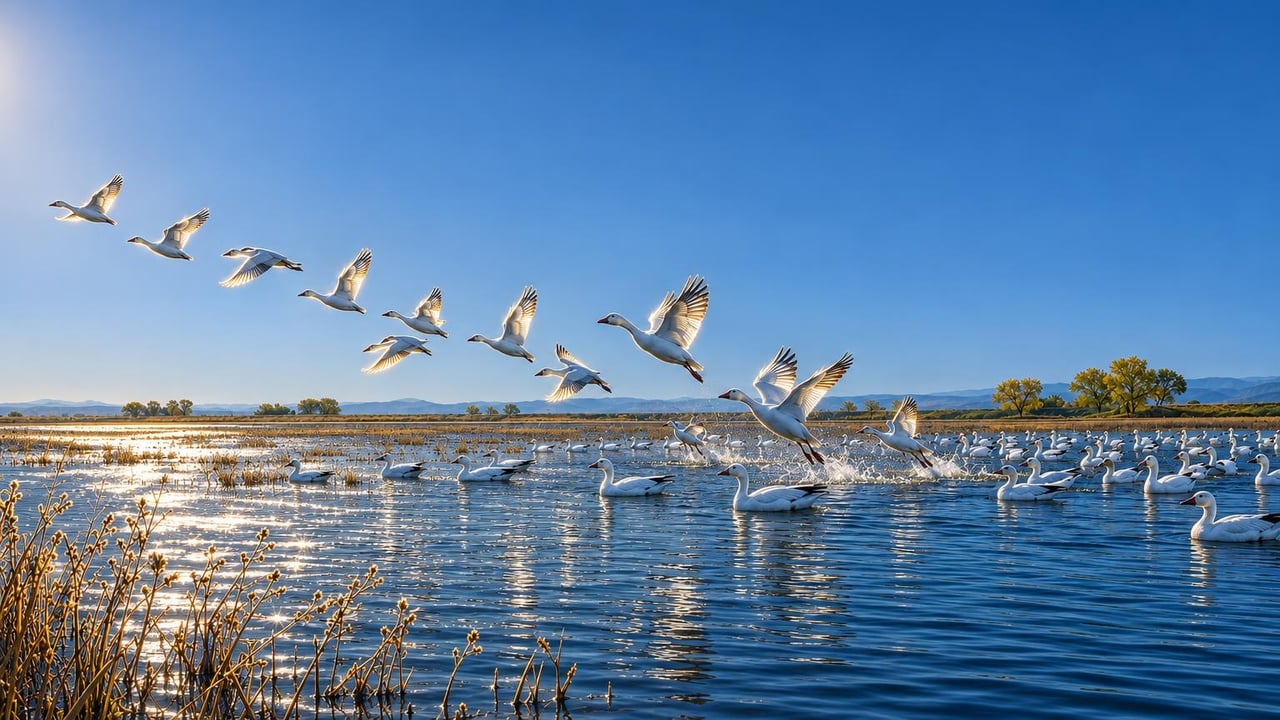
In mid-October, Chico Enterprise-Record columnist Heather Hacking drove out to Llano Seco on Seven-Mile Lane. Water was just starting to trickle onto the land, and the sandhill cranes had already arrived. Her guide predicted that the water would keep rising day by day until the place became a shallow lake. After that would come pintails, shovelers and gadwalls, and maybe a bald eagle following the ducks. Read her column in the Enterprise-Record.
If you have family in town and a free afternoon this holiday weekend, the timing works in your favor.
Chico's Snow Goose Festival of the Pacific Flyway comes to town in late January. The birds keep an earlier calendar. The U.S. Fish and Wildlife Service, which runs the Sacramento National Wildlife Refuge Complex, says geese arrive by the thousands in November and waterfowl numbers peak at the end of the month. The agency's long-run monthly averages show the size of that window. November averages 1.8 million waterfowl across the complex, December 1.4 million, and January 995,000. That makes January barely more than half the November figure.
USFWS labels those figures as averages, not a count from this fall. December brings its own payoff: USFWS says raptor numbers peak in early December as hawks and eagles follow the waterfowl. Goose numbers peak at the end of December, after the ducks spread out across the valley. By January, the agency describes viewing as "less reliable as birds disperse to find food."
So the stretch from Thanksgiving through December is the main event, with overall waterfowl numbers at their high point this week and geese building toward their own peak at the end of December. The January festival comes after both.
The Llano Seco Unit of the Steve Thompson North Central Valley Wildlife Management Area is the site Hacking visited. USFWS puts its visitor area on 7-Mile Lane "just 15 minutes southwest of the city of Chico."
The setup is simple. An observation deck sits at the visitor area. A trail leaves from the deck and runs half a mile through the wetlands to an observation mound with a picnic table, so the walk is a mile round trip. USFWS lists October through February as the season for sandhill cranes and waterfowl there. The site has parking, a restroom, an information kiosk and benches. There's no drinking water, so bring your own, and bikes aren't allowed on the trail.
The trail and visitor area are open every day of the year, from one hour before sunrise to one hour after sunset, with no fee. The refuge complex's current status list shows the Llano Seco trail and observation platform open seven days a week.
Those details make Llano Seco the easy choice for a holiday weekend. It's close enough to go between dessert and dishes, and it costs nothing, which helps if half the car is cousins from out of town. A one-mile round trip with a picnic table at the turnaround also suits a wide range of ages.
The opening hours shape when you should go. USFWS says that in November, "evening fly-offs occur at dusk as birds go out to feed in the rice." Wetlands near Chico are where the flocks rest. The flooded rice fields of the Butte basin are where they eat, and a May 2026 Enterprise-Record column by Laura Lukes describes those fields and the remaining wetlands as rest habitat along the Pacific Flyway. The flight between the two happens around sunset.
Llano Seco stays open until an hour after sunset, so you can arrive in late afternoon, walk out to the mound, and still be there when the flocks lift. Bring binoculars and a jacket. Hacking admits in her column that she's just as likely to forget hers.
Gray Lodge Wildlife Area, near Gridley, is the step up. It's run by the California Department of Fish and Wildlife, and its viewing setup is bigger than Llano Seco's. A three-mile auto loop runs through the area. A 0.3-mile paved Wetland Discovery Trail leads to an elevated viewing platform with scopes, and the two-mile Flyway Loop has two observation hides. CDFW's directions run by way of Highway 99, then Colusa Highway, Pennington Road and Rutherford Road.
The paved trail and the scopes make Gray Lodge a good fit for anyone who can't manage an unpaved mile, or for kids who will get more from a fixed scope than from passing binoculars around. The auto loop also works for a cold, wet afternoon. During the October to February peak, CDFW requires visitors on the loop to stay in their vehicles, and it may restrict walking and biking routes from mid-October to mid-February.
Unlike Llano Seco, Gray Lodge isn't free. The CDFW Lands Pass costs $5.97 for a day or $33.48 for the year in 2026, and the Gray Lodge page lists who needs one. Gray Lodge is open daily from sunrise to sunset, which ends its day earlier than Llano Seco's, so an evening fly-off fits better at the closer site.
Sacramento National Wildlife Refuge, six miles south of Willows on Highway 99W, is the headquarters of the refuge complex and the most developed site of the three. Its six-mile auto tour has two observation decks, a restroom and marked park-and-stretch stops. The auto tour costs $6 a day or $12 a year per vehicle. A valid Federal Duck Stamp or America the Beautiful pass also gets you in. Because the fee is per vehicle rather than per person, one carload of relatives pays the same $6 as a solo birder.
The trails and visitor center are free. Visitor center winter hours, which began November 1, are Friday through Sunday from 10 a.m. to 3 p.m., and the auto tour runs from an hour before sunrise to an hour after sunset every day. If you want the indoor exhibits along with the drive, the Friday or Saturday after Thanksgiving works. The refuge's status list shows the auto tour, trails and restrooms open seven days a week.
At any of the three sites, check before you go. USFWS warns that flooding can happen without warning, that road shoulders are soft and won't hold a vehicle, and that areas can close without notice. It posts changes to the refuge complex status page and its social channels. For Gray Lodge, CDFW keeps a land closure alerts page.
If you'd like someone to tell you which bird is which, AltaCal Bird Alliance, the Chico group formerly known as AltaCal Audubon Society, runs field trips that are free to the public. Each trip requires advance registration and a signed annual liability waiver. Its Llano Seco trip with Joyce Bond is scheduled for Saturday, November 28, with a limit of 15 people. The AltaCal events calendar has the start time and registration, and it also lists a Sacramento National Wildlife Refuge trip in early December.
AltaCal also lists the Chico Water Pollution Control Plant oxidation ponds among its local birding spots, but public access there is docent-led and limited to one field trip a month. Don't go on your own. For a quick look closer to home, Lukes's column names upper and lower Bidwell Park as places to bird any time of year.
The 27th annual Snow Goose Festival runs January 28 through 31, 2027. It has workshops and kids' activities at Historic Patrick Ranch Museum, a dinner banquet with a keynote speaker at Chico State's Bell Memorial Union on Saturday, January 30, and a Birds! art exhibit at the Museum of Northern California Art. The MONCA exhibit stays up from January 14 through March 7. Festival registration opens December 8, and the organizers say the program will include more than 55 field trips. Registration opens while December's goose peak is still building out on 7-Mile Lane.
The deck at Llano Seco is open today, Thanksgiving Day, from an hour before sunrise to an hour after sunset.
At Upside Real Estate, we like the parts of Chico that don't show up on a listing, like a free sunset fly-off 15 minutes from downtown. If you have photos from Llano Seco this weekend, send them our way. For more on life around town, our Chico neighborhood page is a good next stop, and when you're curious what your own place is worth, you can get your free home valuation.
Stay up to date on the latest real estate trends.
You’ve got questions and we can’t wait to answer them.