Durham's Zero-Down Loan Advantage Over Chico Is Real, and It's Shrinking Fast
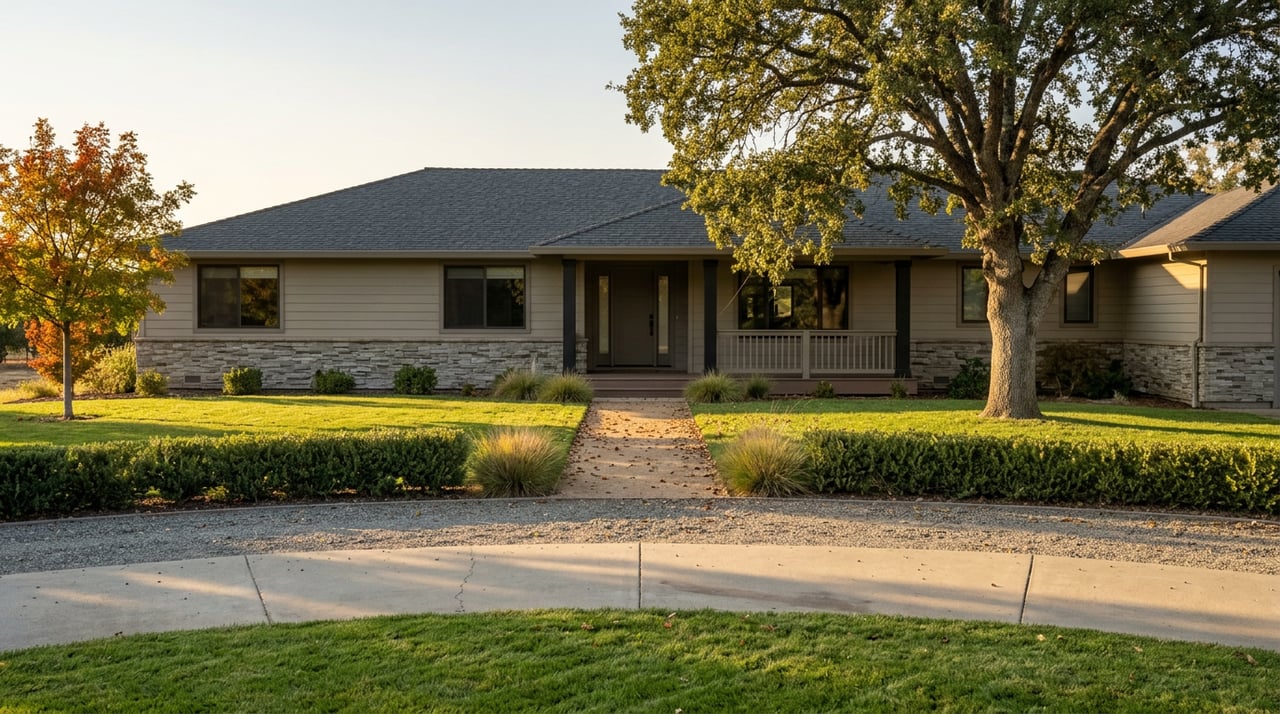
What happens when the only zero-down mortgage program left in Butte County sits almost entirely inside the one town whose prices just outran it?
That's the question loan officers around Chico and Durham keep running into this fall. A buyer finds a house in Durham, gets excited because a lender confirms the address sits inside a USDA Rural Development eligible zone, and then hits a wall a few minutes later when the income math doesn't clear. Meanwhile, the same buyer's second-choice house in central Chico never had a shot at that loan in the first place, eligible income or not, because the zip code itself is excluded from the program. Two very different problems, same outcome: the zero-down loan that sounds like Durham's ace in the hole is getting harder to actually use, right as it stays essentially off the table for most of Chico.
USDA Rural Development loans offer qualified buyers 100 percent financing, no down payment, in areas the agency classifies as rural based on population size and distance from a metropolitan center. Durham has long appeared on the agency's list of eligible Butte County places, alongside towns like Biggs, Gridley, and Forest Ranch. It's a small, unincorporated farm community south of Chico built around Durham Unified's tri-campus and Durham Park, and it fits the program's rural definition without much debate.
Chico doesn't fit that definition, at least not in its core. Zip code 95926, which covers the university area and the neighborhoods immediately around it, comes back completely excluded on USDA's own property eligibility mapping. That's not a surprise once you consider Chico's size: with a population over 100,000, it functions as the anchor of its own metropolitan statistical area, which is exactly the kind of place the USDA program was built to exclude.
Here's where it gets less intuitive. Chico's other zip code, 95973, shows up as almost entirely eligible by area, with only a small sliver excluded. That sounds like it contradicts the first stat, until you remember that 95973 is a sprawling zip code covering hundreds of square kilometers well beyond city limits. The excluded sliver is the built-up part of town. The eligible majority is farmland and foothill parcels that share a Chico mailing address without sitting inside Chico at all. The zip code isn't telling you the city is eligible. It's telling you the countryside around the city is, which is a very different piece of information if you're trying to figure out whether your specific address qualifies.
That's the first real lesson here: eligibility follows a rural-vs-urban boundary drawn by population and census geography, not a town name or a zip code average. The only way to know for certain is to check the exact address on the USDA's own property eligibility tool, not to assume based on whether a place sounds rural.
For years, the working assumption in Butte County has been simple: Chico is the city, Durham is the affordable small town nearby. That assumption doesn't hold up against what's actually moved through the market this year.
Recent local listing data from August 2026 put Durham's typical home in the neighborhood of $745,000 to $815,000, depending on whether you're looking at the trailing 12 months of closed sales or the current list-price snapshot, with year-over-year gains reported as high as 42 to 96 percent depending on the measure. Homes there are also selling fast, with average time on market reported around 13 days. Chico, by contrast, showed a citywide median list price closer to $495,000 as of June 2026, with homes typically taking around 70 days to sell.
Set those two numbers side by side and the old assumption flips:
| Chico (citywide) | Durham | |
|---|---|---|
| USDA zero-down eligibility | Core zip (95926) fully excluded | Listed as an eligible Rural Development place |
| Recent price benchmark | Around $495,000 median list (June 2026) | Roughly $745,000-$815,000 median (12-month sale / August 2026 list) |
| Typical time on market | About 70 days | About 13 days |
Durham isn't the discount alternative to Chico anymore. It's pricier and moving faster. The zero-down loan is sitting inside the more expensive, more competitive market of the two.
USDA loans don't cap how much house you can buy. They cap your household income, and your monthly payment still has to fit standard underwriting ratios on top of that. As of 2026, most program guidance puts the qualifying income ceiling for a one-to-four person household somewhere around $122,800 in a typical area, though published figures vary by source and the real number depends on your county's specific classification. A lender pulling the current Rural Development limit for a Butte County address is the only way to get an accurate answer, but even the higher end of that range creates a problem once you look at what Durham homes actually cost now.
One widely used affordability calculator estimates that a buyer today would need close to $150,000 in annual income to comfortably carry Durham's current median list price with a conventional 25 percent down payment. That's already well above the roughly $122,800 income ceiling that governs USDA eligibility. In other words, the household income high enough to comfortably buy a home near Durham's current price point is likely too high to qualify for the zero-down loan that made Durham financing attractive in the first place. The loan and the price tag have started moving in opposite directions.
There's a second wrinkle worth knowing about if you're pricing land with a house on it, which is common in Durham. A recent snapshot of Durham properties sold with acreage showed an average listing price near $1.6 million and an average cost per acre above $200,000, a figure clearly pulled upward by a handful of larger orchard and estate properties on the market at any given time. Durham typically has only a couple dozen active listings total. Chico, across its zip codes, runs closer to 300 active listings at any given time, and only a small slice of those sit inside the USDA-eligible fringe. When a market as small as Durham's adds even one $1.5 million walnut orchard estate to the mix, the median moves in a way it simply wouldn't in a deeper pool like Chico's. Worth remembering the next time a "median price" headline for a small town looks dramatic.
None of this makes Durham a bad choice or Chico the better one. It means the shorthand most buyers carry into this decision, that the small town is the cheap, zero-down-friendly option and the city is the expensive one, needs an update.
A few things worth doing before you assume either way:
If you're comparing what your household actually qualifies for across Durham, Chico, and the towns in between, that's exactly the kind of conversation worth having with someone who tracks these zip-code-level details for a living. Take a look at what's currently active in Durham and Chico, and when you're ready to see where your own numbers land, Upside Real Estate can walk through the specific financing picture for the address you have in mind. A free home valuation is a good place to start if you're weighing a move between the two.
Does USDA eligibility ever change for a specific address? Yes. Boundaries are tied to population and census data that gets revisited periodically, and sources differ on exactly how often updates happen. Check the map close to when you're ready to write an offer, not months earlier.
If my income is above the USDA cap, am I out of options in Durham? No. Conventional and other loan programs remain available regardless of the property's USDA status. The zero-down loan is one tool, not the only one.
Is any part of Chico actually USDA-eligible? Portions of the rural fringe captured under the 95973 zip code can be, even though the built-up core of the city is not. The only reliable way to know is checking the specific address.
Stay up to date on the latest real estate trends.


You’ve got questions and we can’t wait to answer them.